
Concrete Maturity Meter
Concrete Maturity Meter
Concrete Maturity meter is a device inserted in concrete structure while casting, to monitor the concrete maturity and strength of the actual concrete by measuring temperature variations within the concrete, the device calculates the maturity value to develop a co-relation between maturity and strength, enabling real-time strength monitoring of both precast and cast-in-place concrete and also useful for determining the correct time for foamwork or shuttering removal and to decide when to stretch the tendons in PT Slabs.
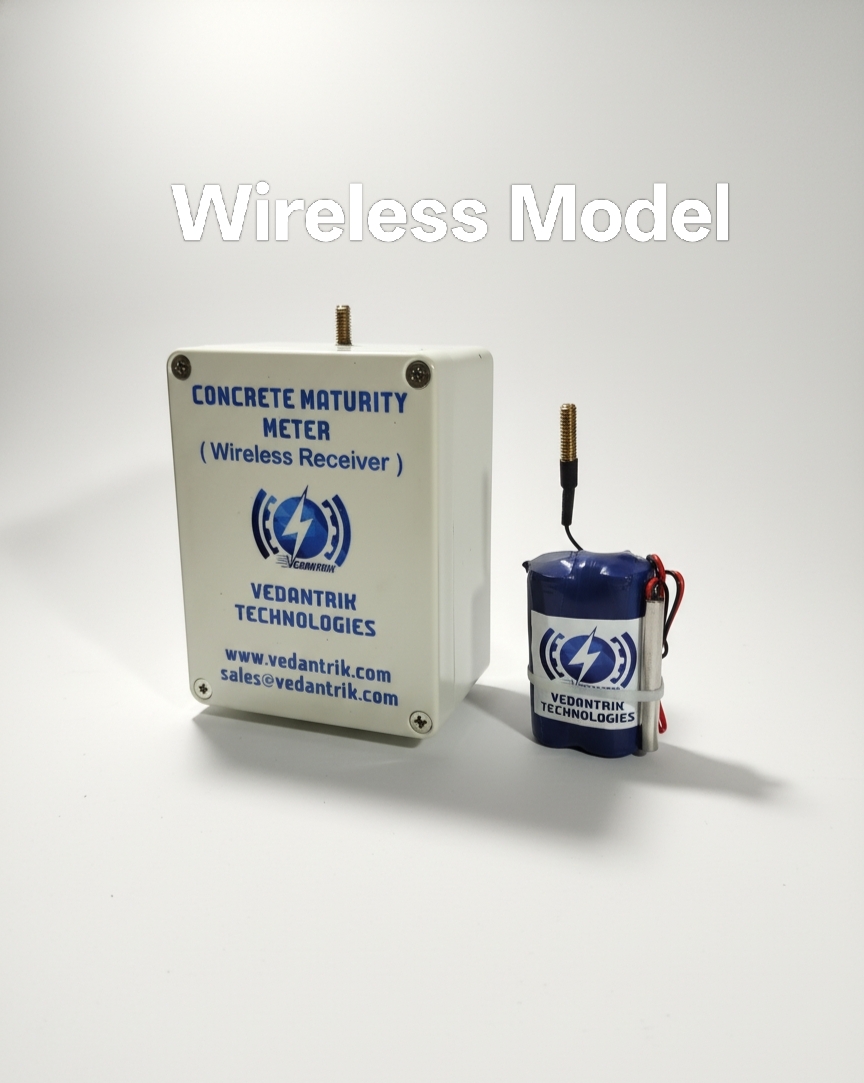
Vedantrik Technologies has developed India’s first Wireless type Concrete Maturity meter and installed it in India’s first bullet train Project at BKC.
Concrete Maturity meter is available in various models like wireless and wired type, Sacrificial and Reusable type concrete maturity meter where only the sensor will be sacrificed and the transmitter part can be reused as per the different different application, concrete maturity meter for Concrete Road and infrastructure Projects, residential project and mass concrete temperature monitoring, temperature differential and for thermal gradient monitoring is also available.
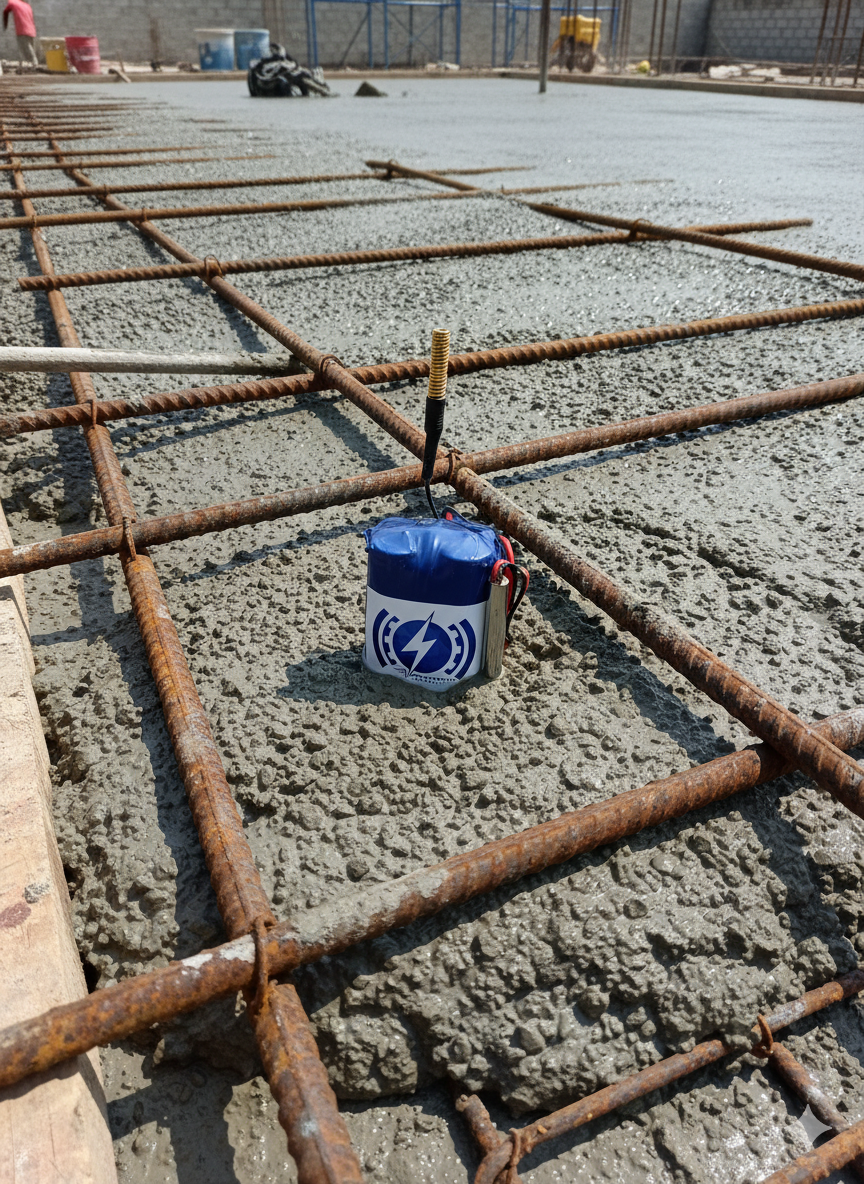
The temperature sensors are embedded into the concrete at the construction site to measure temperature continuously. The maturity value is then calculated based on the recorded temperature data and correlated with the concrete strength. This correlation must be established for the specific concrete mix design As per ASTM C1074 standards and remains valid as long as the mix design does not change.
Types of Concrete Maturity Meter with Various Models
VedaConMat Mass
This model delivers an exceptional wireless range—up to 0.5 km, and up to 1 km with line-of-sight—without internet, unmatched by any other concrete maturity meter in the world.
Designed for real site conditions, once the sensor is embedded in concrete, engineers can monitor data directly from the control or container room, even if the control room or container office is 200–300+ meters away from VedaConMat Mass.
The VedaConMat Mass comes in two part Transmitter and receiver, Part one that transmitter is sacrificial type for one time use integrated with the sensor inserted completely in the concrete, Part two is receiver need to purchase only once which is installed in the control room can be re-used, to access the data Users can directly connect a mobile phone or laptop to the receiver wirelessly to download and view temperature, maturity, and strength data from control room. One such Receiver can connect with 10 Transmitters and each transmitter has 2 or 4 sensing points based on the Transmitter variant you select, which saves huge cost. If you provide wifi internet to the receiver from the control room then data can be accessed remotely from anywhere. Detailed specification is mentioned in the catalog.
VedaConMat Mass 4G
This model is identical to VedaConMat Mass, except it has an inbuilt internet facility for receivers. The Transmitter Parts of VedaConMat Mass can be used with the Mass-4G model, and vice versa. Need for this model was required for location where there is no WiFi internet facility is available, or the site is located at very remote area
Model: VedaConMat Lite 4G
This model comes with the internet inside to upload temperature, maturity, and strength data directly on the cloud to access remotely from anywhere, and complies with ASTM C1074. If internet not available still the data can be downloaded wirelessly connecting with Mobile phone or Laptop (connectivity Range 10-12meters Line of Sight)
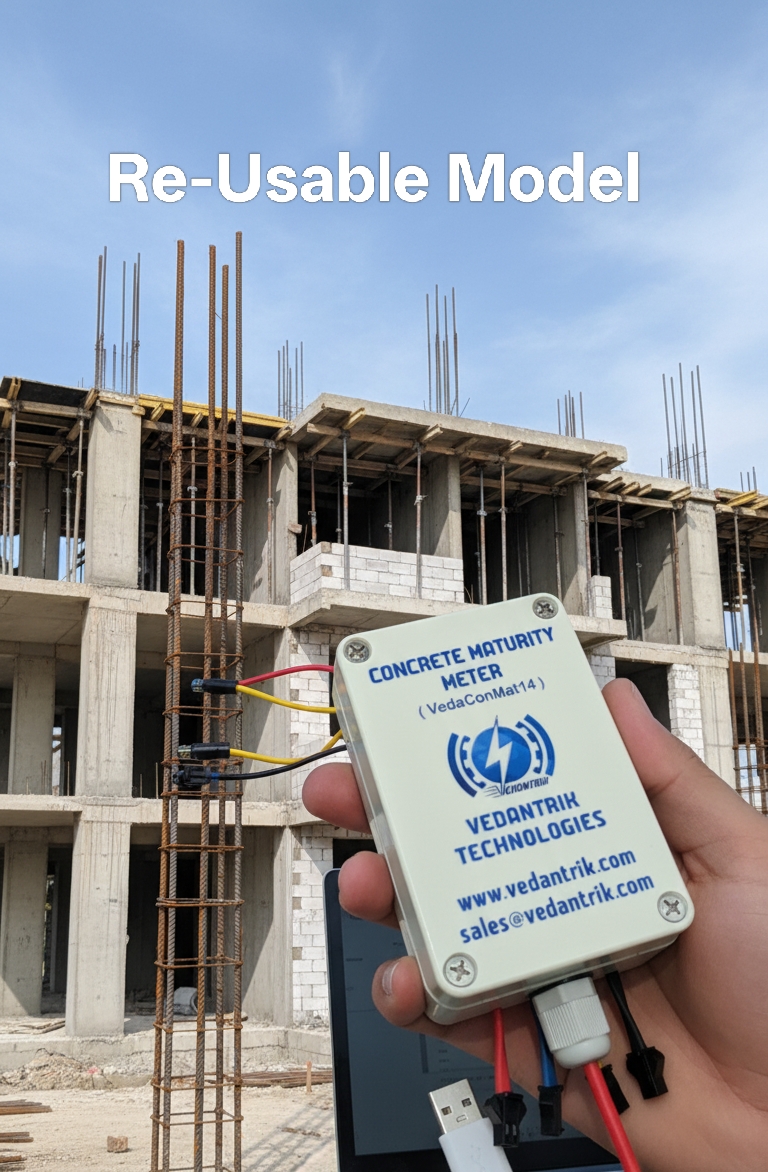
It is a reusable type system: only the sensor is embedded in the concrete, while the main unit—with its in-built battery and internet module—remains outside. The device continuously measures and uploads data in real time.
With four sensor ports, it can monitor four points simultaneously. The main unit is reusable and only the sensor is sacrificial, making it a highly economical option and reducing per-point testing costs. It comes with a one-year warranty and is suitable for laboratory use and precast concrete casting yards, if used with care it can also be used on construction sites. Detailed technical specification is mentioned in the catalog.
Model: VedaConMat Lite R
This model is very much similar to VedaConMat Lite 4G, with the key difference being the absence of built-in internet connectivity. As a result, a Wi-Fi Internet connection is required for data uploads and remote access, or else the person present onsite can connect with Mobile phone or Laptop with the main unit wirelessly (connectivity Range 10-12meters Line of Sight) to download the logged data like temperature, maturity and strength, and complies with ASTM C1074.
It is a reusable maturity meter featuring low-cost sacrificial sensors and an integrated rechargeable battery. Only the sensing elements are embedded in the concrete, while the main unit remains external for ease of access. The device includes four ports, enabling simultaneous monitoring at four measurement points.
It comes with a one-year warranty and is suitable for laboratory use and precast concrete casting yards if used with care it can also be used on construction sites. Detailed technical specification is mentioned in the catalog.
Model: VedaConMat Lite
This is low cost fully embedded in the concrete and fully sacrificial type model, can be used as one time wireless concrete maturity meter, this model is suitable for almost all the application like Residential, Industrial, Infrastructure projects, beams columns slabs and Concrete Road Project. It connects with Mobile phone Laptop or PC wirelessly (connectivity Range 10-12meters Line of Sight) from inside the concrete and Temperature, Maturity and Strength can be Viewed in the Web-software with download facility of historical Data.
With a single unit two Points can be tested for temperature, maturity and strength one where the main body is placed and other where the sensing element is placed, separated by two meter distance which can be extended up to 10 meter with full accuracy. Hence with a single quantity it can be used for two nearby points. Detailed technical specification is mentioned in the catalog.
Model: VedaConMat Lite+
This model is similar to VedaConMat Lite, Low cost fully embedded in the concrete and fully sacrificial, can be used as one time wireless concrete maturity meter, only the advantage in this model is that with a single Unit of this model four points can be monitored for temperature, Maturity and Strength which saves huge cost being sacrificial model, one where the main body is placed and other three within sphere of 2 meters extended up to 10meters with full accuracy.
Suitable for almost all the applications like Residential, Industrial, Infrastructure projects, beams columns slabs and Concrete Road Project. It connects with Mobile phone Laptop or PC wirelessly (connectivity Range 10-12meters Line of Sight) from inside the concrete to view and download Temperature, Maturity and Strength in the Web-software with download facility of historical Data, Detailed technical specification is mentioned in the catalog.
Common Features for all Models
Automatic Data Logging
The device automatically records temperature data at intervals As perASTM C1074.
Web-Based Software for Data Logging and Report Downloading
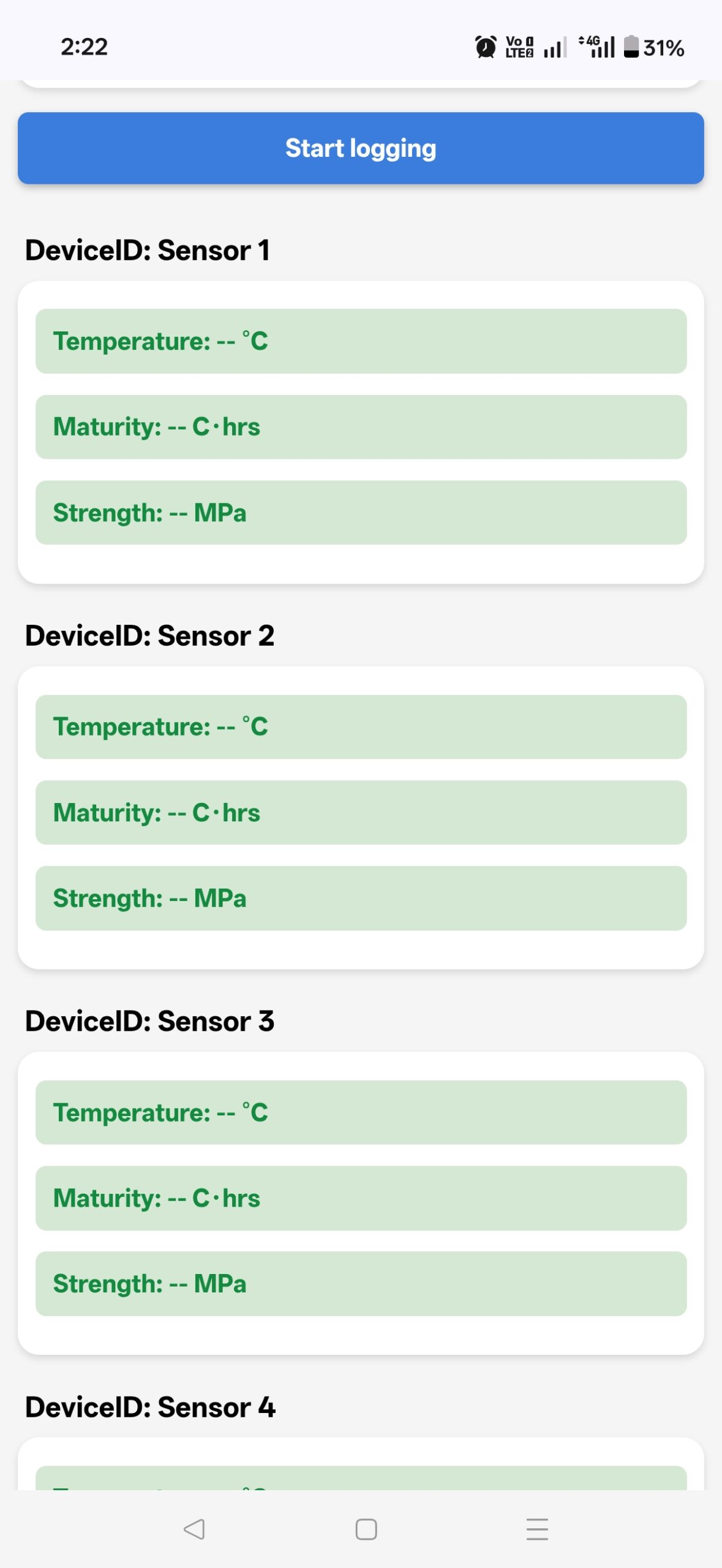
The system comes with easy-to-use web-based software accessible through any device connected to the Hotspot. This software allows viewing real-time data, managing logged data, and downloading detailed reports for record-keeping and analysis.
Graphical Representation
The software provides clear graphical charts that plot temperature changes over time, Maturity vs. Time, Maturity vs. strength. These graphs help visualize the curing process, showing how temperature rises and falls during hydration. Such visual data assists engineers in quickly assessing whether concrete is curing done properly and supports making informed decisions about strength development and construction scheduling.
Monitoring the strength development of concrete during early curing is essential for safe construction scheduling. The Concrete Maturity Meter provides real-time data on temperature history to estimate in-place strength, making it a crucial tool for project managers.
In Mumbai’s high-rise and infrastructure projects, where deadlines are tight, maturity meters allow engineers to determine the right time for formwork removal, post-tensioning, or opening structures to service. Vedantrik Technologies offers advanced maturity meters that are easy to deploy and deliver accurate strength estimations.
By using this device, contractors avoid unnecessary delays while ensuring safety. It reduces reliance on time-based curing estimates and instead relies on actual strength data, leading to better efficiency and reduced costs. For high-performance concrete maturity meters in Mumbai, connect with Vedantrik Technologies and achieve safer, smarter, and faster construction results.
Concrete Maturity method is a fundamental concept that is used to estimate the early-strength development of concrete based on its time & temperature history. It follows the principle that the strength development of the concrete is directly influenced by both time and temperature. The maturity method as defined by ASTM C1074 provides a reliable, non-destructive way to assess the in-situ concrete strength development over time. This standard is widely used in structural monitoring, quality control, and construction scheduling where early-age strength prediction is critical.
Concrete maturity refers to the cumulative effect of both temperature and time on strength development in concrete. The main objective behind the maturity method is that concrete does not gain strength based on age but rather how temperature has influenced its hydration process over time. The process of hydration is temperature dependent, where higher temperature accelerates the reaction and, in turn, the strength gain, while lower temperatures show an opposite effect. Hence maturity is also defined as a time-temperature factor or function. By integrating temperature over time, maturity index can be established, which is typically expressed in °C·hours or °C·days, that correlates with strength development.
The co-relation between maturity and strength is empirical and must be established for each specific concrete design, as it is generally accepted that concrete of a specific mix design will develop the same compressive strength if it reaches the same maturity index, for example if a concrete mix (A) is achieving the maturity index of value Z 0C.hrs in X days at Y 0C , and there is a concrete mix (B) is also achieving the same maturity index that is of value Z 0C.hrs in P days at Q 0C still both will develop same compressive strength as the maturity indexes are same. This assumption enables project teams to assess strength development in real time, improving the quality control without the need of frequent destruction.
Purpose of Concrete maturity method:
- To determine in-situ concrete strength using the time-temperature history of the structure, in accordance with ASTM C1074.
- Provides a non-destructive alternative to traditional testing methods.
- Helps in improving the structural safety by ensuring that critical construction activities are performed only after the concrete has reached the required strength.
- Enhance control over curing conditions by allowing for assessment of temperature related-effects on strength development.
- Supports mix design optimization by allowing the study of variables like admixtures, cement types, or curing conditions effect on strength development.
- Facilitate compliance with standards through data-driven, quantifiable verification of strength development.
Principle behind Concrete Maturity Measurement Method:
The concrete maturity method is an empirical technique employed to predict the development of strength in concrete as a function of its temperature-time history. The fundamental principle underlying this method is that the rate of cement hydration process, along with the consequential strength gain, is not only influenced by the age of the concrete since the time of casting, but primarily by the combined effect of time and temperature. In essence the maturity method is useful in quantifying the degree of hydration by integrating temperature over time, thereby allowing to estimate the strength of in-situ concrete with great accuracy, especially during the early stages of curing.
Concrete strength gain is intrinsically linked to the kinetics of cement hydration, a complex exothermic reaction between water and cementitious materials such as tricalcium silicate, dicalcium silicate, tricalcium aluminate, and tetracalcium aluminoferrite that leads to formation of calcium-silicate-hydrate (C-S-H) gel and other reaction products that contribute materials structural integrity. The rate of these hydration reactions are temperature dependent, so elevation in temperature increases the rate, mainly because of reduced activation energy barrier, while lower temperatures affect it in the opposite manner. However, this same hydration process can result in excessive heat generation that has a direct effect on the morphology and distribution of the hydration products. Hence, it can lead to temperature induced changes in the micro-structures, porosity and micro-cracking due to differential thermal gradients, especially in mass concrete.
Furthermore elevated temperature can also affect the natural evolution of the micro-structures in the concrete, thereby affecting the structural and mechanical properties beyond that could be assessed by the maturity method.
Nurse-Saul Method:
The common approach for estimation of concrete’s strength from its maturity, utilizes the Nurse-Saul method, which assumes that there is a linear relationship between temperature and the rate of hydration. The general formula proposed is expressed in the form given below:
M(t) = ∑ (Ta - T0) * Δt
Where :
M(t) = the temperature-time factor at age t, degree-days or degree-hours, Δt = a time interval, days or hours, Ta = average concrete temperature during time interval, Δt, °C, and To = datum temperature, °C.
Arrhenius Method:
The hydration process can halt altogether if the concrete remains below datum temperature, as it can be assumed that datum temperature sets a critical temperature threshold limit.
Crossing this limit creates a condition where maturity is no longer linear and cannot be predicted until other supplementary cementitious mixtures (SCM) such as accelerators are added into the mix.
In such cases where ambient temperature goes below datum temperature (0°C for India) the Arrhenius method gives a more accurate and reliable result. The Arrhenius method is based on activation energy that captures nonlinear temperature effects more accurately, especially under extreme hot or cold conditions.The general formula proposed is expressed in the form given below:
te = ∑e-Q(1/Ta - 1/Ts) * Δt
Where:
te = equivalent age at a specified temperature Ts, days or h, Q = activation energy divided by the gas constant, K, Ta = average temperature of concrete during time interval Dt, K, Ts = specified temperature, K, and Δt = time interval, days or h.
Measurement of Maturity and strength:
Nurse-Saul function is the widely used method, which assumes that there is a linear relationship between temperature and the rate of hydration. The general formula is expressed in the form given below:
M(t) = ∑ (Ta - T0) * Δt
Where :
M(t) = the temperature-time factor at age t, degree-days or degree-hours,
Δt = time interval, days or hours,
Ta = average concrete temperature during time interval, Δt, °C, and
To = datum temperature, °C.
After calculating the maturity values for each of the specified curing days and determining the corresponding compressive strengths from the CTM (Compression Testing Machine) results, plot a graph of maturity index versus compressive strength. Fit a trend-line to the data to identify the best-fit relationship, typically a logarithmic regression provides a good representation of the strength development in relation to maturity.
Fc = a + b * log10 (M)
Components of Concrete Maturity Method:
- Temperature Monitoring Equipment - Devices to measure and record concrete temperature over time.
- Concrete Strength Testing - Standard strength tests (e.g., ASTM C39 – Compressive strength of cylindrical concrete specimens).
- Reference Temperature - A specific temperature used in maturity calculations. For Nurse–Saul, the typical reference is 0°C (32°F) unless otherwise specified.
- Concrete Mix Design Information - The maturity method is mix-specific; a separate calibration curve is required for each mix.
- Data Collection and Analysis Tools - Software or spreadsheets to calculate maturity and estimate strength. Ensures real-time tracking and reporting.
Standard procedure: Overview (as per ASTM C1074)
1. Objective of Maturity Method Calibration (Co-Relation Establishment)
The primary objective of the calibration process in ASTM C1074 is to establish a reliable relationship between concrete maturity and its compressive strength for a specific concrete mix. This relationship—called the strength–maturity curve—enables users to estimate in-place concrete strength based on temperature history rather than destructive testing. Since the maturity method is mix-specific, each unique concrete mixture requires its own calibration.
2. Selection and Preparation of Concrete Mix
The calibration begins by selecting the specific concrete mix that will be used in the field. This includes confirming the materials, proportions, and mixing procedure. Fresh concrete from this mix is then used to cast a set of standard specimens depending on the project requirements, which will be cured and tested over time to develop the strength–maturity relationship.
3. Temperature Monitoring of Specimens
To track the maturity development, thermocouples or temperature sensors are embedded in at least two of the cylinders immediately after casting. These sensors record the internal temperature of the specimens continuously over time. The temperature data is used to calculate the maturity index using either the Nurse–Saul function or the Arrhenius function, as specified in ASTM C1074.
4. Curing and Strength Testing Schedule
The concrete specimens are cured under standard laboratory conditions, and are tested for compressive strength at multiple time intervals; for example, at 1, 3, 7, 14, and 28 days. The specific times should span the range of expected strengths during field monitoring. At each test age, the corresponding maturity index is calculated based on the recorded temperature history.
5. Developing the Strength–Maturity Relationship
After collecting the strength and maturity data at each age, the results are plotted with concrete strength on the y-axis and maturity index on the x-axis. A best-fit curve (usually exponential or logarithmic) is applied to the data points to define the strength–maturity relationship for the given concrete mix. This curve becomes the foundation for estimating in-place strength based on measured maturity in the field.
Result Interpretation of Concrete Maturity Method:
Result interpretation in the maturity method involves comparing the maturity index (°C·hours or °C·days) calculated from the in-situ concrete to a previously developed calibration curve that relates maturity to compressive strength. By identifying the maturity value measured in the field and locating that point on the calibration curve, the corresponding compressive strength can be estimated. This allows for a reliable prediction of the in-place concrete strength at any given time, provided the conditions match those used during calibration.
When maturity and strength relation established becomes invalid
If Mix design changes. (Cement/Admixture/Chemicals/etc) calibration becomes invalid ,This can be considered as advantage instead of disadvantage, like if mix design changes, maturity vs time response will vary.
Co-relation established in winter will not be valid in summer or vice versa.
Ambient condition (do not insert concrete cube in curing Tank at the time of co-relation establishment as the actual concrete structure can not be immersed in curing tank)
Small concrete used during Co-relation establishment, hence this co-relation will not be valid for Mass-Concrete due to Thermal-Gradient
- Various Names and Tags: Concrete Maturity, Concrete Maturity Method, Concrete Maturity Meter, Concrete Maturity Testing, Maturity Method Concrete Strength, Maturity Sensor for Concrete, Concrete Strength Maturity Curve, Nurse-Saul Maturity Formula, Temperature & Time Factor Method Concrete Maturity, Strength vs Maturity Relationship, How To Calibrate Concrete Maturity, Weighted Maturity Function Concrete, ASTM C1074 Maturity Method, Datum Temperature Concrete Maturity, Concrete Maturity Monitoring System, Temperature Sensor in Concrete Maturity, Real Time Concrete Maturity Monitoring, Maturity In Mass Concrete, Concrete Strength Monitoring System.
- Experience the elite standard in concrete technology with our Splendid Concrete Maturity Meter, masterfully engineered for heavy-duty industrial usage. Crafted with excellent precision, this high-quality tool features a robust 5 HP motor and operates efficiently at 220V, making it a top choice for professionals. Its multicolour design enhances visibility and usability on site. Manufactured and supplied by industry leaders in India, this tool ensures accuracy in measuring concrete maturity. Shop now for a masterful solution order today and elevate your construction projects to excellence!
Concrete Maturity Meter: Usage Directions & Product Advantages
Our Concrete Maturity Meter is simple to usejust install it within freshly poured concrete to monitor real-time temperature and strength progression. Its durable material composition ensures longevity and resilience on-site. The meter offers competitive advantages such as high measurement accuracy, rapid response times, and easy integration into industrial workflows. Ideal for structures requiring precise curing data, it helps reduce labor costs and project timelines, ensuring superior quality control and reliability every time.
Concrete Maturity Meter: Payment, Sample Options & Shipping
We provide multiple payment terms to suit client needs, from secure online options to traditional bank transfers. Sample units are available upon request and follow our transparent sample policy, allowing you to evaluate performance before large orders. Shipped goods are packed securely and dispatched using trusted transport services, ensuring safe delivery. Please contact us for the latest asking price and sample conditions. Our support team assists in tracking your shipment until it arrives safely and on time.
FAQs of Concrete Maturity Meter:
Q: How does the Concrete Maturity Meter work in industrial environments?
A: The Concrete Maturity Meter measures temperature and estimates the strength of concrete by monitoring maturity, ensuring accurate data for project decisions even in demanding industrial sites.
Q: What are the key benefits of using this Concrete Maturity Meter?
A: Benefits include high measurement precision, robust durability, fast setup, and easy integration with existing systems, leading to better project quality and shortened construction timelines.
Q: When should the Concrete Maturity Meter be installed during the concrete process?
A: For optimal results, install the meter immediately after pouring the concrete to enable continuous monitoring from the start of the curing process.
Q: Where can I purchase this masterful Concrete Maturity Meter?
A: You can order today directly from the manufacturer or supplier based in India. Vedantrik Technologies sales@vedantrik.com
Q: Is a sample of the Concrete Maturity Meter available before placing a full order?
A: Yes, we offer sample units for assessment under our sample policy. Please get in touch for availability and sample shipping details.